
If you run a Calgary business and want more customers from Google, you will probably face the same question sooner or later: should you put your budget into SEO or Google Ads first?
There is no universal answer. This SEO vs Google Ads Calgary comparison looks at how each channel works, what needs to be in place before you invest, and how to choose based on your timeline, website, search demand, and ability to measure qualified leads.
Key Takeaways
- Google Ads can put a business in paid search results relatively quickly once a campaign is active, but every campaign still depends on targeting, landing pages, budget, and measurement.
- SEO usually takes longer because search engines need to crawl, understand, index, and evaluate your pages before meaningful organic visibility develops.
- A weak website can limit both channels. More traffic does not fix unclear service pages, poor mobile usability, or a confusing conversion path.
- Calgary businesses with an immediate need for enquiries may test paid search first if they already have strong landing pages and reliable tracking.
- Businesses with a longer planning horizon may benefit from building organic search visibility around commercial services, local searches, and useful pre-sale questions.
- SEO and Google Ads do not need to compete for the same role. They can support different stages of the same customer journey.
SEO vs Google Ads Calgary: how the two channels differ
SEO and Google Ads can both bring people to your website from Google, but they do it in fundamentally different ways.
Search engine optimization (SEO) focuses on improving your site’s content, technical structure, relevance, and usability so search engines can understand the pages and decide when they are useful for organic searchers.
Google’s SEO Starter Guide describes SEO as helping search engines understand your content while also helping users find your site and decide whether they should visit it. It also makes clear that there is no method that automatically guarantees a first-place ranking.
For a Calgary business, SEO may involve:
- Creating dedicated pages for important services instead of listing everything briefly on one homepage.
- Making titles, headings, internal links, and navigation clearer.
- Fixing pages that search engines cannot crawl or index properly.
- Building useful content around questions customers ask before contacting a provider.
- Improving location relevance where Calgary or another service area genuinely matters.
- Maintaining accurate local business information.
- Improving the mobile experience and conversion path after someone reaches the site.
Businesses exploring this route can review Clio’s Calgary SEO services for an example of how technical SEO, content, and search visibility can fit into a broader strategy. Clio currently presents technical audits, content, and link building as parts of its Calgary SEO offering.
Google Ads operates differently.
With paid search, you create campaigns, choose targeting and budget settings, and pay for eligible ad interactions. You have greater short-term control over which services are promoted and which landing pages receive the traffic.
That makes Google Ads useful for testing commercial demand. It does not mean the campaign will automatically generate profitable leads.
If the keywords are too broad, the geography is wrong, the landing page is unclear, or the tracking is broken, paid traffic can become expensive without telling you much about the business.
A practical SEO versus Google Ads comparison
| Factor | SEO | Google Ads |
| Visibility | Usually develops gradually | Can begin after campaigns become active and eligible |
| Cost structure | Strategy, content, technical work, and ongoing improvements | Media spend plus campaign setup and management |
| Traffic after spending slows | Existing organic visibility may continue | Paid traffic generally falls when campaigns stop |
| Search testing | Slower because pages need time to gain visibility | Useful for testing commercial searches more quickly |
| Local reach | Website relevance, local content, Business Profile, and other signals | Geographic campaign targeting |
| Measurement | Search Console, analytics, calls, forms, and CRM data | Ads data, conversions, calls, forms, and CRM data |
| Landing pages | Important | Especially important because weak visits consume budget |
| Typical role | Building longer-term organic coverage | Shorter-term demand testing and paid visibility |
The biggest mistake is comparing the channels only by traffic.
Traffic is not the business outcome.
A page can rank and still generate weak enquiries because the query has poor commercial intent. A paid campaign can report a healthy click-through rate while attracting people who never become realistic customers.
A better question is:
Which channel can bring qualified opportunities from the website you have now?
Calgary search also includes local results
For many local businesses, organic blue links are only part of the search experience.
Google Business Profile and map-based results can be important when someone searches for a nearby service.
According to Google’s local ranking guidance, local results are mainly based on relevance, distance, and prominence. Google also recommends keeping Business Profile information complete and accurate so it can better understand when a business matches a local search.
This matters because local SEO and traditional website SEO overlap but are not identical.
Imagine two Calgary physiotherapy clinics.
The first clinic has dedicated treatment pages, a clear Calgary location, accurate business information, useful service descriptions, and a complete Business Profile.
The second clinic runs paid ads but sends everyone to a homepage that lists ten treatments in a few sentences.
The second clinic can buy visibility, but advertising does not fix the experience after the click.
That is why website quality should be part of any Calgary PPC vs SEO decision. Strong Calgary web design should support both channels with usable service pages, responsive layouts, and clear paths for visitors who want to enquire. Clio’s current Calgary web design page includes responsive design, WordPress development, SEO, eCommerce, and website maintenance among its service areas.
When Google Ads may make sense first
There are situations where waiting for organic visibility is not practical.
Paid search can be useful when the business has an immediate goal and already has a website capable of converting traffic.
You need to test commercial demand quickly
Suppose you launch a Calgary commercial cleaning company.
The website is new, so it has little organic search history. You believe office cleaning is the strongest service, but you do not yet know which searches will produce realistic enquiries.
Waiting for SEO alone to answer that question could take time.
A small, carefully controlled paid search campaign can provide faster feedback about commercial intent.
You can evaluate:
- Which search terms produce relevant visitors.
- Which services attract interest.
- Which landing pages generate enquiries.
- Which messages lead people to take action.
- Which terms consume budget without producing useful outcomes.
This does not mean launching hundreds of keywords.
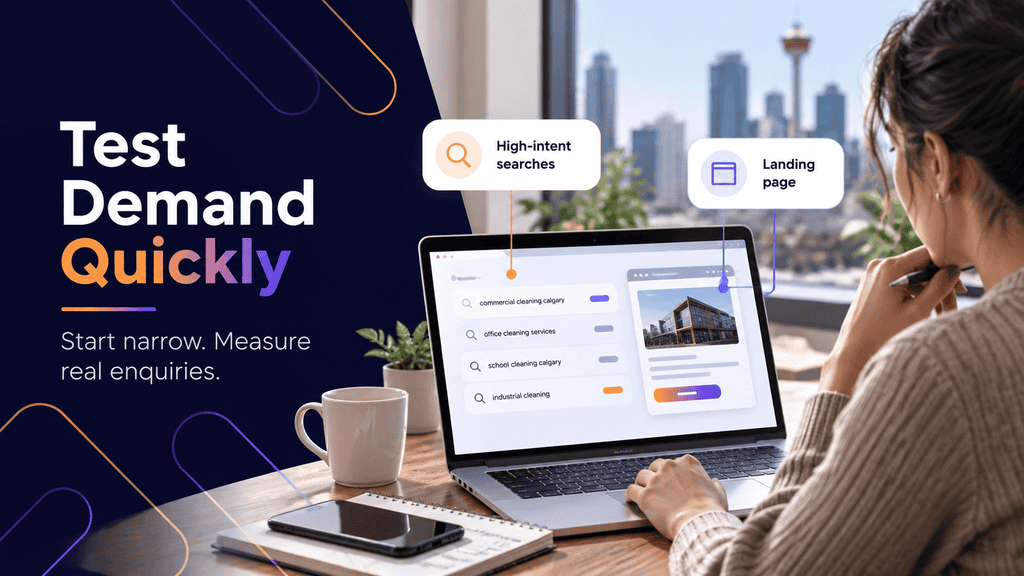
Start with a narrow set of services that have clear commercial intent. Review the actual search terms that trigger your ads, exclude irrelevant searches, and send each group to a page that closely matches the service being advertised.
For a Calgary business considering this approach, a focused digital advertising strategy should connect targeting, search intent, ad messaging, and the landing page instead of treating them as separate tasks.
Your need is time-sensitive
Paid search can also make sense when the business has a reason to generate visibility now.
Examples might include:
- Launching a new service.
- Opening an additional location.
- Filling spare appointment capacity.
- Supporting a seasonal service.
- Testing a newly created landing page.
SEO may still be part of the plan, but it may not address the immediate timing requirement.
Google Ads also provides geographic controls. Google’s location targeting documentation explains that advertisers can target geographic areas and adjust whether ads reach people based on physical location, location interest, or both. Google also notes that location signals are not perfectly accurate in every case.
That detail matters for a Calgary service company.
If your team only works within Calgary and selected surrounding communities, there is little value in paying for large numbers of clicks from people outside your service area. Location settings, negative keywords, and ongoing search-term reviews can help reduce obvious waste.
You already have a usable landing page
Google Ads can expose landing-page problems quickly because every visit has a direct cost.
Before increasing the budget, check the page from a prospective customer’s perspective.
Does it clearly answer:
- What service is being offered?
- Is it relevant to the search that triggered the ad?
- Does the company serve Calgary or the searcher’s area?
- Is there enough information to judge whether the service is suitable?
- Is the next step obvious?
- Does the page work well on mobile?
Sending paid traffic to a generic homepage is often avoidable.
A dedicated landing page can give one search intent a clearer destination. Clio’s guide to landing page design covers common landing-page considerations and why the page visitors first reach matters to the campaign.
Your conversion tracking works
Clicks are not enough to evaluate a campaign.
Before spending heavily, decide what counts as a meaningful conversion.
For a local service business, that could be:
- A qualified quote request.
- A booked consultation.
- A phone call.
- An appointment request.
- An online purchase.
- A completed lead form that meets specific criteria.
Google defines conversion tracking as a way to measure whether ad interactions lead to valuable actions such as sales, leads, phone calls, or sign-ups. It can also help identify which ads and keywords are associated with those outcomes.
Test the setup before relying on the numbers.
Submit the form yourself. Call the tracked number. Check whether one enquiry produces multiple duplicate events. Confirm that the website and advertising account are recording the actions you actually care about.
Otherwise, you may make budget decisions based on inaccurate data.
When SEO may make sense first
Google Ads is not automatically the better first move simply because it can create visibility sooner.
SEO may deserve priority when the business’s larger problem is its website, search coverage, or content structure.
Your service pages are too weak for either channel
Consider a Calgary contractor whose homepage briefly mentions roofing, windows, siding, renovations, and emergency repairs.
Each service gets one sentence.
That structure creates problems regardless of whether visitors arrive organically or through an ad.
Someone searching specifically for a roof replacement still needs to work out:
- Whether the company performs that type of project.
- Which properties it works on.
- Which locations it serves.
- What the process involves.
- Why a prospective customer should trust the business.
- How to request an estimate.
Paying for more visitors does not solve those gaps.
The better first step may be building useful service pages with clear content, supporting proof, sensible navigation, and specific calls to action.
Those pages become assets for both channels.
SEO gets clearer pages to index and understand. Paid campaigns get better destinations for high-intent traffic.
Customers research before they are ready to buy
Many businesses focus only on searches that look like immediate sales opportunities.
That can overlook a large part of the customer journey.
A Calgary property manager evaluating roofing work may first search questions such as:
- How often should a commercial roof be inspected?
- What causes ice dam damage?
- When should a flat roof be replaced?
- Can roof repairs be performed in winter?
- What should a commercial roof inspection include?
Those searches do not necessarily produce an immediate quote request.
They can still introduce the business to a potential customer before the final provider comparison.
This is where SEO can support more than service pages.
Useful articles, FAQs, technical explanations, and planning resources can answer genuine questions while strengthening topical coverage around the services a company wants to be known for.
The important part is usefulness.
Do not create 30 short Calgary SEO articles simply because keyword software found 30 variations.
Each page needs a distinct purpose.
Google’s Search Central guidance consistently encourages content created for people rather than pages produced mainly to attract search traffic. Its documentation also stresses making content easy for search engines to crawl, index, and understand.
You already have pages with organic potential
SEO does not always mean starting from zero.
Before creating more pages, review what your existing website is already doing.
Google Search Console can help you identify pages and queries that have some visibility but are not yet performing as well as they could.
Look for:
- Important service pages receiving impressions but very few clicks.
- Queries where your page appears for the wrong intent.
- Pages with useful impressions but weak titles or descriptions.
- Commercial pages with little internal linking.
- Several pages competing around nearly the same topic.
Sometimes the strongest opportunity is an existing page.
For example, if a Calgary accounting firm’s corporate tax page already appears for relevant searches, it may make more sense to strengthen that page than publish another article targeting a slightly different version of the same query.
Improve the information on the page. Clarify the service. Add useful supporting sections. Strengthen relevant internal links.
That is often more focused than creating another URL simply because a keyword tool produced a new variation.
How to choose which channel to prioritise
Instead of asking whether SEO or Google Ads is better overall, evaluate what the business needs right now.
A simple five-step process can make the decision much easier.
1. Define the business outcome
Start with what you actually want the marketing channel to produce.
“More traffic” is too vague.
A Calgary law firm may care about enquiries for a particular practice area. A commercial supplier may care about quote requests from companies that meet a certain order threshold. An eCommerce business may care about completed purchases from a specific product category.
Define the outcome before comparing channels.
That keeps you from choosing based on vanity metrics.
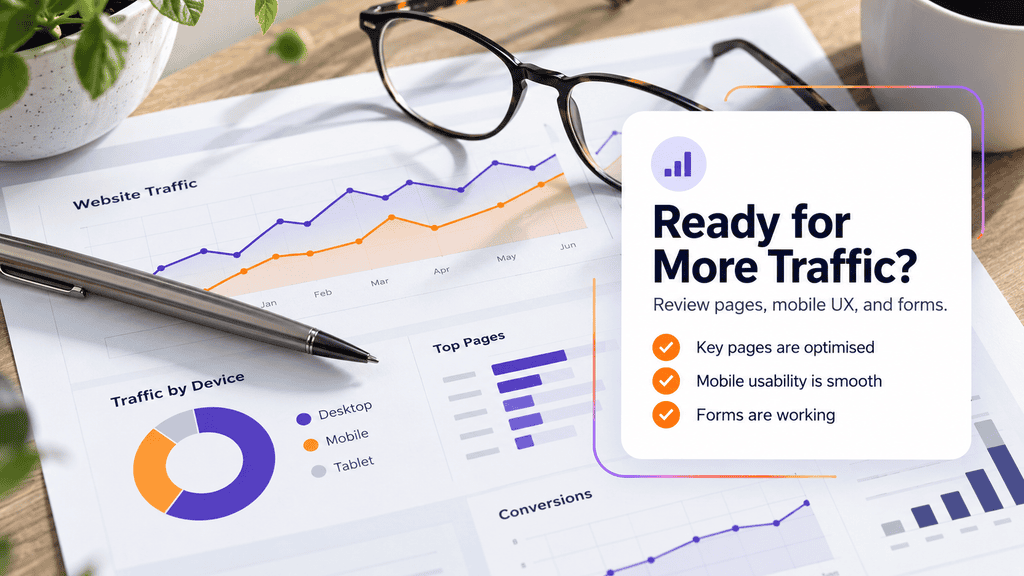
2. Check whether the website is ready for more traffic
Review the pages that would receive organic and paid visitors.
Ask:
- Does each important service have enough information?
- Is the next action clear?
- Is the site usable on mobile?
- Are forms working?
- Is contact information easy to find?
- Does the page match the visitor’s search intent?
- Can you tell where enquiries came from?
If the answer to several of those questions is no, website work may come before a large marketing investment.
3. Separate urgent demand from long-term demand
List the searches most closely connected to a sale.
Then separate them from educational or research searches.
For example:
High commercial intent:
“commercial furnace repair Calgary”
Research intent:
“why commercial furnace keeps shutting off”
The first may be appropriate for a tightly controlled paid campaign and a strong service page.
The second may be better served through an educational article that builds organic coverage and helps a potential customer understand the problem.
Both queries can matter. They simply play different roles.
4. Decide what you can measure properly
You should be able to connect marketing activity to real outcomes.
At minimum, confirm how you will track:
- Forms.
- Phone calls.
- Purchases.
- Bookings.
- Consultation requests.
- Qualified leads inside your CRM, if one is used.
The more clearly you can connect search traffic to business outcomes, the easier it becomes to decide whether the channel deserves additional investment.
5. Review lead quality, not only channel reports
A Google Ads dashboard can tell you how many conversions were recorded.
Search Console can tell you which queries and pages are gaining organic impressions.
Neither tool can fully tell you whether those enquiries were valuable to the business.
Talk to whoever handles sales, bookings, or customer enquiries.
Which leads became real conversations?
Which services generated worthwhile opportunities?
Which searches consistently attracted the wrong type of customer?
That information should influence both your paid search and SEO priorities.
How SEO and Google Ads can work together
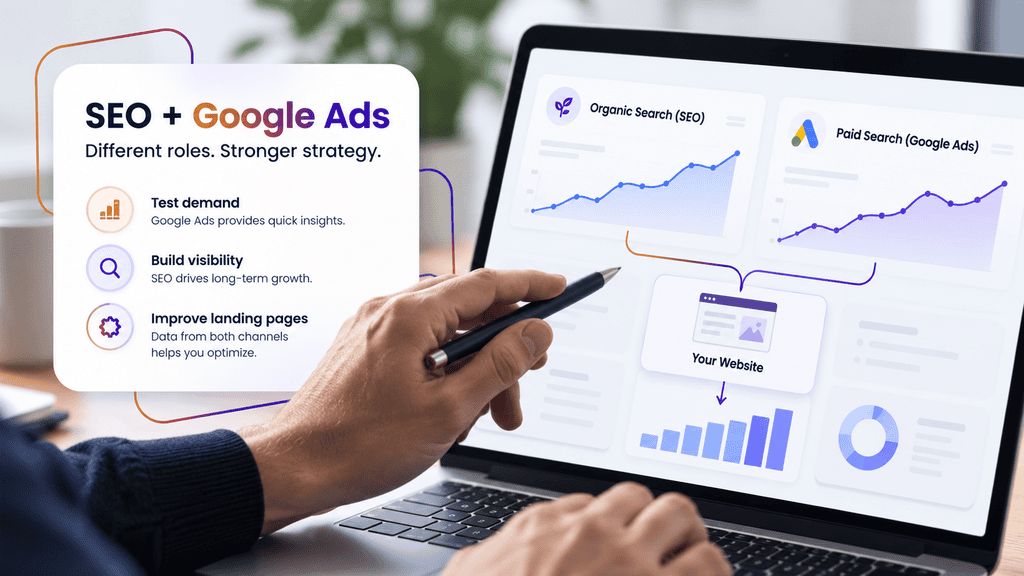
For many Calgary businesses, the practical answer is not choosing one channel forever.
It is giving each channel a clear job.
Paid search can test high-intent demand while SEO develops broader organic visibility.
SEO can strengthen service pages that later become better paid landing pages.
Google Ads search-term data can reveal how prospective customers describe a service, although advertising data should not automatically dictate the entire SEO strategy.
Organic search can also cover informational topics that would be inefficient to target heavily with paid ads.
A hypothetical Calgary accounting firm
Consider a hypothetical accounting firm that wants more corporate tax clients.
Its website is established, but the corporate tax section is weak and organic visibility is limited.
The firm could begin with a narrow Google Ads campaign around high-intent corporate tax searches.
Those ads would lead to a dedicated service page with clear information and a consultation form.
At the same time, the business could improve the organic side by:
- Strengthening the corporate tax service page.
- Creating useful supporting content around common corporate tax questions.
- Improving internal links between relevant pages.
- Making location information clear where Calgary relevance matters.
- Reviewing Search Console for additional search behaviour.
After several months, the business should have more information than it had at the start.
It can compare which paid searches generated qualified consultations, which organic pages gained meaningful visibility, and which topics attracted traffic without producing useful opportunities.
That is much more informative than assuming “SEO is cheaper” or “Google Ads works faster.”
Do not make the two channels duplicate each other
Using both does not mean every keyword needs an ad and an SEO page.
Assign roles based on intent and business value.
For example:
| Search situation | Possible role |
| High-intent service query with immediate demand | Paid search and a strong commercial landing page |
| Important service the business wants lasting visibility for | Dedicated SEO service page |
| Early-stage customer question | Educational SEO content |
| New service with uncertain demand | Small paid search test |
| Existing page already gaining organic impressions | Improve the current page before creating another |
| Seasonal or short-term promotion | Paid campaign may be more appropriate |
This keeps the strategy focused.
It also reduces the risk of spending money on traffic while simultaneously creating large amounts of overlapping content that serves no clear purpose.
Start with the problem you need to solve
The SEO versus Google Ads decision becomes clearer when you define the business problem first.
If you need to test commercial demand quickly and already have a strong website, paid search may provide useful short-term feedback.
If the larger issue is weak service pages, limited organic coverage, poor local relevance, or a website that does not answer customer questions well, SEO and website improvements may deserve priority.
Whichever direction you take, measure qualified business outcomes rather than traffic alone. That will tell you far more about whether SEO, Google Ads, or a combination of both deserves the next part of your budget.
FAQs
Is SEO cheaper than Google Ads in Calgary?
Not automatically. SEO does not charge for each organic click, but it still requires investment in content, technical work, website improvements, and maintenance. Google Ads has visible media spend, so comparing the channels by monthly fees alone does not tell you which one produces better business results.
How quickly can Google Ads start working?
A campaign can begin receiving impressions and clicks once it is active and eligible, but clicks do not guarantee leads. Results depend on search demand, competition, targeting, budget, ad quality, the landing page, and whether conversion tracking is configured correctly.
How long does Calgary SEO take?
There is no reliable timeline that applies to every business. A new website entering a competitive market is in a different position from an established site that already receives search impressions. Existing authority, competition, technical health, content quality, search intent, and local relevance can all affect progress.
Should a new Calgary business start with SEO or Google Ads?
A new business may use a small paid campaign to test high-intent search demand while it builds its organic foundation. If the website is incomplete or the service pages are weak, however, improving those pages may be more useful than buying more traffic immediately.
Do Google Ads improve organic rankings?
No. Paid ads and organic search results use separate systems. Buying Google Ads does not purchase a higher organic position, although paid campaign data may help a business better understand commercial search behaviour.
Does Google Business Profile count as SEO?
It is an important part of local search visibility, but it is not the whole of local SEO. Your website, business information, reviews, links, relevance, location, and other signals can also influence how the business appears in local search.
Can a small business use SEO and Google Ads at the same time?
Yes, if the budget and website can support both. The channels should have defined roles. You might use paid search for immediate high-intent demand while SEO builds stronger service pages, local relevance, and useful content over time.